2013年 1月 10日 by びっくり
My first desires to visit Kyushu (九州・きゅうしゅう) arose in 1989 after hearing personal tales of Kagoshima (鹿児島・かごしま) from a native. Since moving to Japan in 2004, additional tales of Kumamoto (熊本・くまもと) and other Kyushu regions trickling in have given me a longing feeling, or more accurately – a lacking feeling. More recently, receiving foods and hearing of Nagasaki (長崎・ながさき) from one of the officiants at our wedding has planted another reason drawing me there.
We have visited her many times; however, she lives in Chiba (千葉・ちば) which is in the opposite direction. We joked about taking a trip together to her hometown, but getting everyone together never seemed practical and it just remained a dream. Japanese tradition has provided us with opportunity. Our friend got pregnant and still, in many households, the pregnant daughter returns to her family home to have the baby. On New Years Day she delivered her son after almost two full days of labor and they are both resting and recuperating now.
My wife is busily checking ways to get to Nagasaki during the three-day weekend in February. We have been surprised at the expense, but there is some hope of finding cheaper options. It will be a struggle for us as we have some financial difficulties and we are trying to fly to America in June as well after a three year absence; however, it looks like our chance so we must find a way.
It would be nice to see the Sakurajima volcano in the south, or the wild forests of Kumamoto, or remote Saga, but those dreams will have to wait as we will probably be bound to Nagasaki for our brief stay. Ancient new year celebrations will be held at that time though, so we are interested to view customs from another region.
Tags: 長崎, February, festival, Kyushu, Nagasaki, New Year, 九州
Posted in 生活と文化(life and culture), 観光(sightseeing), personal, 旅行(travel) | 2 Comments »
2013年 1月 9日 by びっくり
 Normally I like my hair trimmed short and my beard nicely groomed around the mouth and jaw; however, being a white man in Japan, I am often recruited to be Santa at parties and such. Anyone knows that kids are clever and wearing a fake beard is just inviting the little investigators to invoke accusations of being an impostor. Stemming that tide as well as possible, I often grow out my beard in December.
Sort of tangential to that, I also relied on “hair mascara” in the past to whiten the beard and my eyebrows – to really sell that image. This season, I used no artificial coloring, but found that two years of married life have given me enough whitening.
Recently a friend linked a video about how to shave a beard. One key point was to resist the temptation to play beard games. I’ll just come right out and say, I have never and probably never will be able to resist the play time.
 Once all the parties had ended my better half pressed me to take action in the facial hair reduction realm. I hollered out from the vanity announcing that I had trimmed off the cheeks. Delighted responses came back from the kitchen. I made an appearance and for awhile she was cheering with delight; that is, until she really noticed the sideburns. Don’t worry, they are completely gone now, but I made her immortalize them with the camera before hacking away.
Tags: beard, Japan, mascara, mutton chop, Santa, shave, white
Posted in humor, personal, 写真(photos) | 3 Comments »
2013年 1月 7日 by びっくり
Today is the Seventh of January which is the traditional day to eat nanakusagayu (七種粥・七草粥). Seven Spring greens are gathered and cooked into a rice porridge. Traditionally these greens are:
- seri (芹・セリ) – Japanese parsley, dropwort
- nazuna (薺・ナズナ) – Shepherd’s purse
- gogyo (御形・五形・ゴギョウ), also called hahakogusa (ハハコグサ)
- hakobera (繁縷・ハコベラ) or hakobe (ハコベ) – Chickweed
- hotokenoza (仏の座・ホトケノザ) – from the Chrysanthemum family
- suzuna (菘・スズナ) – Turnip greens
- suzushiro (蘿蔔・清白・スズシロ) – Japanese radish greens
As I wrote last year, the flavor is very grassy and not so popular with children. I think this is one tradition that is slowly vanishing. Even my wife, who had to maintain these traditions for the children under her care, has forgotten it this year.
Perhaps we really need to find ourselves a plot of land to grow things. Had I been preparing these in the garden and talking about them, surely it would be on her mind.
Tags: chickweed, dropwort, garden, Japan, porridge, season, shepherd's purse, Spring, tradition, winter, 七種粥
Posted in 生活と文化(life and culture), 食べ物・食品(food), observations, 日本語 (Japanese) | Leave a Comment »
2013年 1月 4日 by びっくり
Happy New Year! 2013 is the year of the snake, which is my year according to the Chinese zodiac.
I’m not much of one for resolutions; however, this year I have resolved “to live”. First, let me alleviate fear in any of my panic prone friends: I don’t have some kind of terminal illness. Simply I have been battling personal conflicts which have been horribly demoralizing. Over the past several years I have been struggling to rectify the situation; yet, some troubles are extremely persistent.
My hope is that my two largest struggles will be coming into check this year, but that was my hope last year and the year before. Even if things move on the path I hope, it will be six years before the main struggle is gone. Over the last year or two I have felt myself shrinking away from life and have come to the realization that even if the trials are festering I need to live and grow.
Some people viewing from the outside might look at all the things I have done and think that I have been rising above the troubles; however, it is easy for me to see the things I want to improve and change and realize how much time was lost in the last couple years doing nothing.
One clear sign is the number of posts on my blog. When I am feeling depressed or uninspired, I generally don’t post. Other creative outlets have also suffered in this time. Looking forward to my year!
Tags: 2013, conflict, Life, mental-health, New Year, resolution, snake, struggle, trial
Posted in personal | 3 Comments »
2012年 9月 8日 by びっくり
 Goya grow on climbing vines from just behind the flowers, much like a cucumber; however, they have a bumpy flesh that is generally known for it’s bitterness. Often prepared with scrambled egg, onions, and pork in Okinawan cooking, it is liked and hated by roughly equal numbers of people. In our hot climate, it has been trendy to grow “green curtains” of these vines outside windows in an attempt to stay cool. We opted to follow the trend this summer and have been treated to shade, good food, and learning for our efforts.
 One interesting point of learning is that, the bitter green goya are actually less than fully ripe. Allowing them to ripen past the normal harvest time, sees them change to yellow or bright orange coloring. Additionally, the bitterness is greatly tempered; in some cases, even resulting in a bit of sweetness. Harvesting this late can be a bit tricky in that the goya will start to rot on the vine and bugs or birds may take an interest in dining before the farmer.
 Green goya seeds are normally carved from the inside and thrown out; although some will tempura fry them. In the case of a fully ripened goya, the seeds become harder but the flesh around them turns sweet and red – almost like jam.
Tags: bitter, flesh, goya, green, Japan, orange, red, seed, sweet, yellow
Posted in 食べ物・食品(food), observations, 写真(photos) | 1 Comment »
2012年 9月 6日 by びっくり
Every March, when the school year comes to a close, it is common to receive trophies, letters, or other presentations from the students. Sometimes spontaneous movement of the children’s hearts prompts it. Other times, teachers assign it to get pupils to unwittingly practice their language arts skills. Regardless of origin they are always enjoyable to read: first, because they are moving; and second, because they are cute.
Definitely, children say the darndest things and one sadness is that I can’t afford to store all the cards, letters, and presents for posterity: partly for fire safety reasons.
Last Spring, at one of my favorite schools, each second grade class had a representative write a letter for everyone. Instructions from the teacher indicated that group opinion – rather than personal – should be expressed. I included one letter here from a boy who couldn’t resist slipping in a sentence about his regrettable memory from my class. He placed it in the middle and the teacher, busy wrapping up the school year, didn’t catch it; but we had some laughs when I showed it to her.
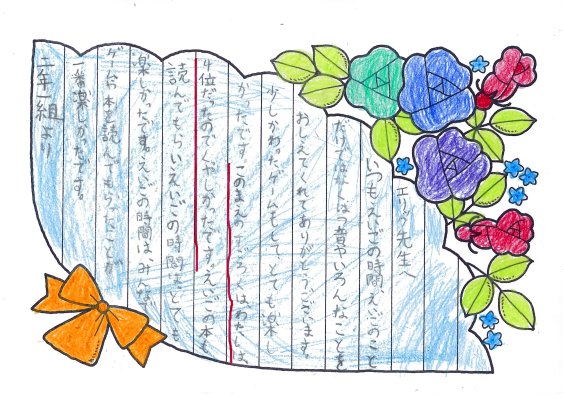
Dear Erik, thank you for always teaching us so much more than English, like pronunciation and many other things. Your slightly ‘unconventional’ games are also very fun. “Recently when we played the board game, much to my chagrin, I came in fourth.” When you read picture books to us we really enjoy it. Everyone feels that when we play games or you read to us, those are the most enjoyable times. From Second grade, class 1
Tags: cute, group, Japan, letter, Mie, opinion, personal, regret, school, Tsu
Posted in humor, observations, personal, 学校 (public school), 日本語 (Japanese) | 3 Comments »
2012年 9月 5日 by びっくり
School has started up again, but I won’t teach any classes until Friday. This can be the most boring time of the year when it seems that work has started but it really hasn’t. I am feeling a little anxiety about Friday because it will be open house. Nobody is ever certain who might show up to watch on those days and the students are probably still in summer vacation mindset.
Adding to the stress this year is the lack of preparation meetings. Real teachers were given extra time off this summer, so while I was sitting in empty school offices to not burn my remaining holidays, the teachers were off enjoying themselves and we couldn’t meet up to discuss how to approach the second term.
With all that time away from work, you would think there were lots of stories to tell; but, almost without exception, teachers here feel an aversion to ever admitting they were not busy or – worse yet – they enjoyed themselves. Asking about the holidays always nets some answer filled with vaguaries and mumbles which generally ends in whining about some professional development meeting they had one day.
Along with the new term, I will be turning a new leaf and trying to post more regularly again. Lots has been going on, including some travel, some learning, and some personal development.
Tags: boredom, Japan, new term, summer vacation
Posted in observations, personal, 学校 (public school) | 4 Comments »
2012年 8月 8日 by びっくり
Today is a banner day – that is to say, I updated the banner image today. Previously I had used an image of rotting fishing ropes, but was constantly troubled with how to make the text legible over that image. The new image is from the photo trip to Shinojima for their Gion festival.
I pulled a lot of the color and contrast out of the background using GIMP; hoping that this would make it easier to view the blog title. Also, for visual reasons I wanted the strong lines in the image to be nearly horizontal. Someone with a sharp eye will notice that flags rarely flutter horizontally and the image is rotated 25 degrees counter-clockwise.
Tags: Aichi, boat, festival, flag, GIMP, Gion, Japan, Shinojma
Posted in 観光(sightseeing), observations, 写真(photos), 撮影(photography), 旅行(travel) | Leave a Comment »
2012年 8月 1日 by びっくり
My father-in-law has two main hobbies: one is pottery and the other is playing the shakuhachi (尺八). Almost exactly four years ago he started teaching me how to play. Almost exactly three years ago I was hit by a car while cycling. One of the saddest parts of that was how it knocked a lot of the creativity and inspiration out of me. After that I put the instrument down for a long time and took care of other, less creative things; however, this week – mostly thanks to my kitten – the shakuhachi is back in my hands.
Monday I made sure I could still make sounds and then practiced the basic notes. Tuesday I ran through several fingering exercises and played one song. Today I practiced all the fingering exercises and played a couple songs. Running out of breath and getting dizzy is the most significant trouble right now. One small problem is that my soul patch is too bushy and makes it hard to keep the instrument in the right location. Judicious use of scissors will correct the small problem. Hopefully daily practice will correct the other.
Tags: accident, health, Japan, kitten, mental-health, Mie, recovery, shakuhachi, tradition, Tsu, wife, 尺八
Posted in 生活と文化(life and culture), 練習 (practice/drill), 音楽(music), personal | 5 Comments »
2012年 7月 27日 by びっくり
For about nineteen years, Fritz and Fred were my sweet kitties. Both of them brought me much joy and it has been hard being without them here in Japan; however, on Sunday the 22nd a new kitty came to live with us. Another foreign national in Geino-cho collected a stray and couldn’t care for it, so we took him on.
We are calling him Smoky. His fur is two shades of gray and his eyes – although green – have an appearance of misty grayness. After we assigned the name, we realized he also has the tendency to vanish like smoke. Often we can hear his bell, but can’t find him anywhere. I uploaded six photos to this set in Flickr, please have a look. Here is one of the images for those of you who just want a peep.
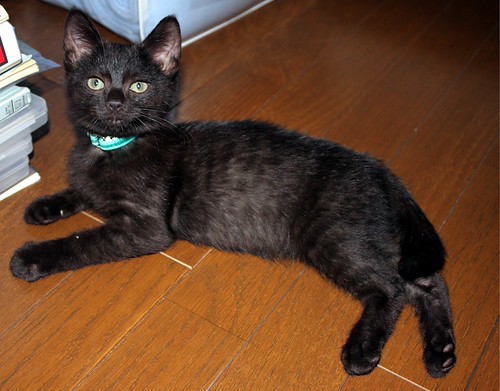
He had worms and eggs in his intestines, a fungal infection in his eyes, and an infection in his nose. All of these are fairly common in strays in Japan. We are giving him medicines now, but he seems pretty much healed now and has tons of energy.
Tags: cat, gray, healthy, infection, kitten, medicine, Smoky, striped, two shades of gray, worms
Posted in personal, 写真(photos) | 4 Comments »

 Neo-新びっくりブログ